
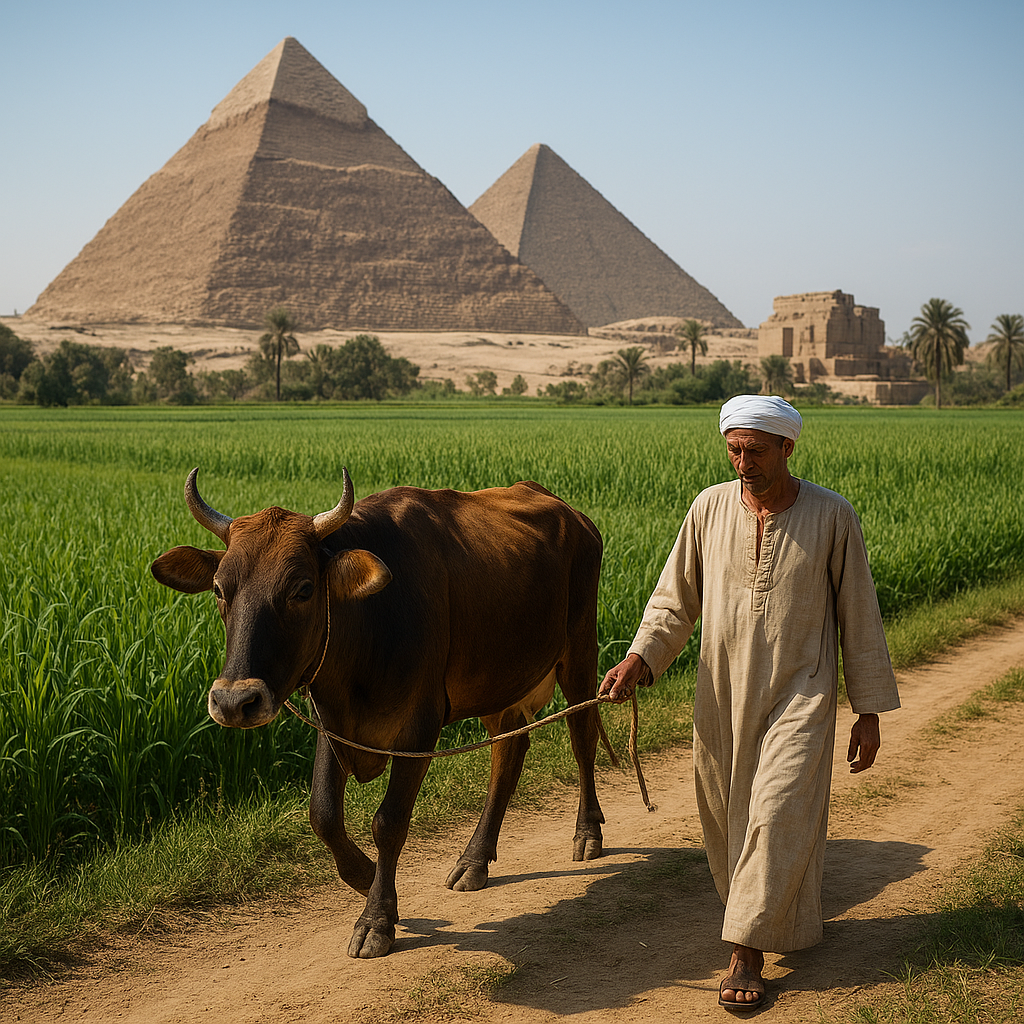
Agriculture formed the foundation of ancient Egypt’s economic system. Nile farming produced food and surpluses that supported households, workshops, temples, and royal projects. Wealth, taxes, and payments frequently involved goods and labor rather than coins. Craft production, livestock, mining, and trade added other sources of value.
So, how did ancient Egypt make money? That question has three parts: how institutions collected resources, how ordinary people earned a living, and how payments worked. The answers changed over time. Ancient Egyptian history spans thousands of years, not one unchanging economic system.
What Was Ancient Egypt’s Economy Based On?
Nile Agriculture and Food Surpluses
The Nile River made farming possible across a landscape surrounded by desert. Its annual inundation, or seasonal flooding, watered the floodplain and deposited sediment. As Britannica’s overview of ancient Egypt explains, the river and its agricultural landscape were fundamental to the civilization’s development.
Farmers grew wheat and barley for bread, beer, and other food, while flax supplied fibers for linen. Gardens and orchards added vegetables and fruit. Irrigation, including basins and channels, helped communities manage water, although techniques and arrangements varied by place and period.
The flood was not a guarantee of prosperity. Too little water could reduce the land available for cultivation; excessive flooding could damage settlements and fields. Harvests also depended on labor, maintenance, and local conditions.
When production exceeded immediate consumption and seed requirements, agricultural surplus could support people who were not farming full-time. Grain stores and granaries held provisions for households and institutions. Stored food helped sustain craftspeople, administrators, transport workers, and building crews.
Crafts, Livestock, and Natural Resources
Farming was central, but it was not the whole economy. Textile workers turned flax into linen. Potters made containers for cooking, storage, and transport. Carpenters, metalworkers, and stoneworkers produced tools, furniture, vessels, and architectural elements.
Livestock supplied meat, milk, hides, transport, and agricultural power. Animals were valuable assets, though their ownership and uses differed across households and institutions.
Quarries supplied building and decorative stone, while mining provided materials such as gold and copper. Some products met everyday local needs; others supplied institutional workshops or circulated over longer distances. A household pot and a finely worked gold ornament belonged to different production networks, even within the same broad economy.
How Did the Egyptian State Obtain Wealth?
Taxes and Deliveries in Kind
Royal institutions obtained resources partly through agricultural deliveries and other obligations. Many were paid in kind: with actual goods rather than coins. Grain was especially useful because it could be stored, measured, and distributed.
Scribes—trained specialists in writing and recordkeeping—recorded land, produce, deliveries, and distributions. Officials supervised collection and storage. UCL’s material on administration in ancient Egypt outlines the institutions and officials involved in managing resources.
There was no single tax rate that applied throughout Egyptian history. Obligations depended on the period, the institution involved, and the status of land or producers. Nor was every delivery necessarily a tax: produce might also come from an institution’s own estates or other arrangements.
Labor Obligations and Institutional Estates
Resources included people’s work as well as stored goods. Authorities could organize labor for construction, transport, quarrying, and maintaining agricultural infrastructure. These arrangements were not identical to modern paid employment, but labor obligations should not automatically be described as slavery either.
Monumental construction involved workers with different skills, roles, and conditions. Treating every builder as enslaved hides that variety.
Royal and temple estates controlled land, workshops, stores, and personnel. They organized production and redistributed resources, meaning that goods collected or produced in one setting were allocated elsewhere. Temple estates were economic institutions as well as religious centers, although their size and influence changed.
The Metropolitan Museum’s account of Egypt in the Old Kingdom places royal construction and resource mobilization within the organization of that particular period. Its evidence should not be treated as a template for every later century.
The following table summarizes major mechanisms, not a fixed model for all Egyptian history.
| Economic mechanism | What it involved | How it supported the economy |
|---|---|---|
| Agricultural production | Crops and other farm products | Provided food, seed, and potential surplus |
| Taxes and deliveries | Goods supplied to institutions under varying obligations | Supplied administration, stores, and institutional activities |
| Labor obligations | Work required or organized by authorities | Supported building, transport, and other projects |
| Craft production | Manufactured goods from households and workshops | Met household and institutional needs |
| Trade | Exchange within Egypt and beyond | Provided access to goods and resources |
How Did Ordinary Egyptians Earn a Living and Pay for Goods?
Farming, Skilled Work, and Household Production
Many Egyptians worked in agriculture, but livelihoods also included herding, fishing, carrying goods, making pottery, weaving, and skilled construction. Work could take place within a household, on an estate, or in an institutional workshop.
Household production mattered because families made or processed much of what they used. Preparing food, brewing beer, spinning thread, and producing textiles all created economic value, even when no separate payment changed hands.
A livelihood could combine several activities. A household might cultivate land, receive provisions connected with institutional work, and exchange some of its own products. That is different from imagining everyone either receiving a salary or depending entirely on state handouts.
Payments in Kind and Standards of Value
Payments could consist of grain, textiles, or other commodities. Grain allocations might maintain workers and their dependents, but their meaning depended on context. A provision issued to support someone’s work was not necessarily equivalent to a modern cash salary.
Three ideas need to stay separate:
- A physical payment was what actually changed hands, such as grain or cloth.
- A unit of account was a standard used to express or compare value.
- A minted coin was a physical piece of money issued with an identifying mark and recognized weight or denomination.
The deben was a weight-based standard that could be used to express value. It was not an Egyptian coin. Its weight and application changed over time, so it should not be assigned one universal equivalent across all periods.
A value expressed through a metal-weight standard did not necessarily mean that metal was handed over. Goods could settle an obligation whose value had been calculated using that standard. Accounting and physical payment were connected, but they were not the same thing.
No coins does not mean no prices, no accounting, or no way to compare the value of different goods.
Did Ancient Egypt Use Money?
The answer depends on what “money” means. If it means widely circulating minted coins, that describes later phases of Egyptian history more readily than much of the pharaonic period.
If money includes goods used to make payments or standards used to express value, the picture is broader. Grain and metals could perform monetary functions in particular settings. Commodity money means a useful material serving a payment function, rather than a coin whose role rests primarily on its recognized monetary status.
Coinage became more prominent in later periods, especially under Ptolemaic rule. Even then, coins did not instantly replace every payment in goods. Different methods could exist side by side.
What Role Did Trade Play?
Domestic exchange connected producers and consumers within Egypt. Food, pottery, textiles, animals, and other products moved between settlements and regions. The Nile provided an important transport route, although moving goods still required boats, crews, organization, and suitable conditions.
Long-distance connections helped obtain materials that were scarce or unavailable locally. Three examples show both the range of goods and the need for historical caution:
- Timber from the Levant: Egypt obtained imported wood, including cedar associated with Byblos, for uses requiring timber different from locally available supplies. Such connections existed during the Old Kingdom.
- Gold from Nubia: Southern gold-producing regions were important to Egypt’s access to precious metal, particularly during the New Kingdom. Its movement involved institutional control and deliveries as well as exchange, so “commercial imports” is not always an accurate label.
- Aromatic products from Punt: New Kingdom expeditions, notably one associated with Hatshepsut, brought back valuable aromatic materials and other goods. Punt’s precise location remains debated.
Not everything arriving from abroad was ordinary trade. Diplomatic gifts, compulsory deliveries, and state-sponsored expeditions followed different arrangements from a negotiated purchase. Likewise, goods moving within Egypt might be institutional distributions rather than market transactions.
Trade complemented agriculture. It widened access to materials and specialist products, but imported luxuries did not replace the harvest as the foundation supporting most people’s lives.
Ancient Egypt’s Economy: Key Facts at a Glance
- Agriculture was the economic foundation, with Nile conditions strongly affecting production.
- Royal and temple institutions collected, stored, managed, and redistributed substantial resources.
- Goods and labor could meet obligations that were not paid in coins.
- Households created value through farming, skilled work, and domestic production.
- Domestic exchange and long-distance connections supplied goods beyond what individual households or regions produced.
- Economic practices changed over thousands of years; no single payment or administrative system explains every period.
FAQ
Was Ancient Egypt a Barter Economy?
Only partly. Direct exchanges of goods existed, but “barter economy” leaves out accounting, standards of value, payments in commodities, institutional allocations, and later coinage. It is too narrow a label for the whole economy.
How Did Pharaohs Become Wealthy?
Royal institutions drew on agricultural surplus, estates, deliveries, organized labor, and access to valuable resources. These supported administration, building, religious activities, and royal households. State resources should not all be treated as a ruler’s personal spending money.
Did Ancient Egyptians Receive Wages?
Some institutional workers received compensation in kind, including grain and other provisions. Such payments could function as wages, but arrangements differed. Evidence about particular organized workforces does not mean every Egyptian earned a regular wage.